
Choose your country

Pulldown 2
Pulldown 2
Pulldown 2
Pulldown 2
Pulldown 2
Pulldown 2
Pulldown 2
Pulldown 2
Pulldown 2

Energy Reduction in Baggage Handling

Rotterdam The Hague Airport
(The Netherlands)

The customer

Rotterdam The Hague Airport (RTHA) is actively working to reduce its overall energy consumption in response to grid congestion and increasing sustainability requirements. As part of this strategy, the airport identified its baggage handling system (BHS) as a relevant energy consumer: Together with NACO, Netherlands Airport Consultants and other key partners, it initiated a live pilot project to validate the potential of energy-efficient components under real operating conditions.

The objective was clear: measure and demonstrate tangible energy savings without compromising operational reliability.

This pilot was carried out in collaboration with Forbo Movement Systems, SEW, Vanderlande and NACO.

Forbo offered to install its energy-saving Amp Miser BHS belts with a lower coefficient of friction, expecting to reduce energy consumption.
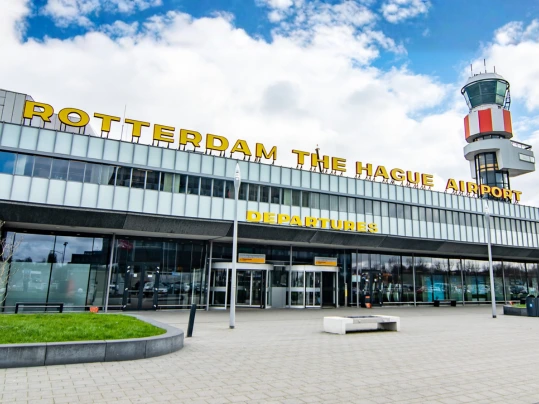
Rotterdam The Hague airport

The application

The pilot was implemented within the transport section of the airport’s baggage handling system, located between the check-in area and the main BHS hall. Four conveyor sections were selected for the test setup, allowing direct comparison between a control configuration and upgraded components.

Energy consumption was monitored continuously over a period of approximately six months, from January to August 2025.

Measurements were taken every ten minutes using external logging equipment connected directly to the conveyor drives.

To ensure meaningful results despite varying baggage volumes, performance was evaluated using the key metric of energy consumption per bag per day (kWh/bag/day). This approach made it possible to assess true efficiency improvements under live airport conditions.

Airport Rotterdam Belt Drive
Airport Rotterdam

Our belt solution

Forbo Movement Systems contributed to the pilot by installing the Amp Miser energy-saving belt, a solution specifically designed to reduce energy demand in baggage handling applications. The belt features a lower coefficient of friction, which reduces resistance between the belt and the conveyor structure. As a result, less drive power is required to move baggage through the system, directly lowering energy consumption.

In addition to the belt installation, SEW introduced a new IE5 high-efficiency drive combined with a frequency converter.

While this contributed to additional improvements, the pilot was particularly focused on understanding the impact of reduced belt friction as a major lever for energy savings.

Key solution elements included:

- Forbo Amp Miser belt with reduced friction for lower energy demand

- Proven suitability for continuous airport baggage handling operations

Does your BHS have similar challenges?

Summary of findings

The pilot results clearly demonstrate that the installation of the new Forbo belt delivers a measurable and sustained reduction in energy consumption.

Across the monitored sections, the Amp Miser belt achieved a stable reduction of 15–25% over the long term.

Based on the complete installation results, the project team calculated the potential impact for a comparable baggage handling system with approximately 400 meters of conveyor length and a throughput of around 400 bags per day.

Such a system could achieve annual energy savings between 2,537 and 4,229 kWh, corresponding to yearly cost savings of approximately €386 to €643.

Most importantly, the measured reductions remained consistent over time and were independent of daily fluctuations in baggage volume, proving the robustness of the solution.

During the test period (January–August 2025), overall energy consumption decreased by approximately 40%, because higher daily bag volumes lead to lower energy consumption per bag. Meaning that higher load increases the realistic energy-saving potential significantly further.

Amp Miser energy-saving belts

Lower power consumption | Substantially reduced energy costs |
Fewer CO₂ emissions