Topaz chooses Eternal Next
Fast, future-proof loose lay solution with project vinyl


Emptying a hallway, removing the old flooring, levelling, applying new adhesive and then laying a new floor. In many buildings, that is a fairly standard renovation job. But in a healthcare institution, things are different: residents continue to live there, and care and daily life carry on as normal.
That is why the floor in a Topaz residential care facility is being renewed with Eternal Next, a loose lay floor from our fast flooring programme . Thanks to an adhesive-free installation method, the floor is installed faster and rooms can be used again quickly. Exactly what is needed in a building where care is non-stop.
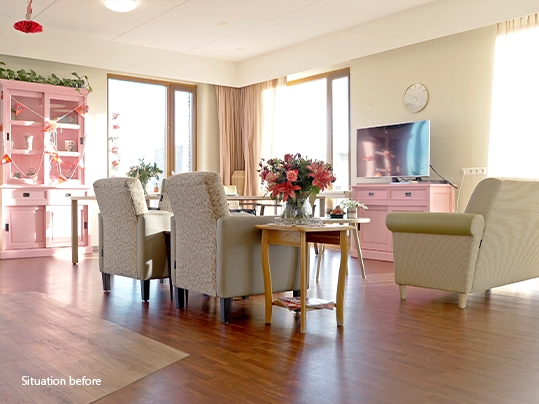
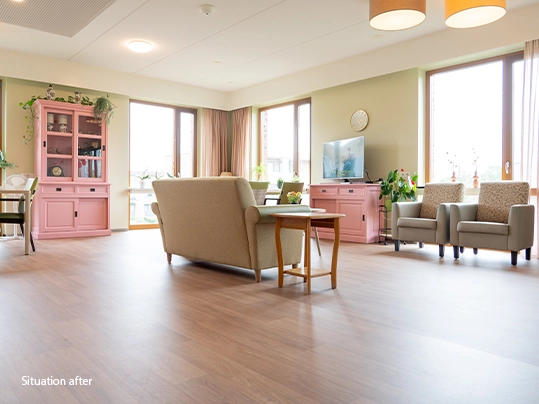
The existing flooring no longer met the care organisation’s needs and showed visible signs of wear and damage after years of intensive use.
“The old flooring was around twenty years old and very dark,” explains Joost Peschier, Real Estate Project Manager at Topaz. “For residents living with dementia, a dark floor can sometimes look like a hole, causing them to try to step over it.
This can be unsettling and create a risk of falls.”
Topaz therefore chose lighter flooring with a wood-effect finish. Its natural appearance and warm tones create a calmer, more welcoming atmosphere, helping residents experience the building as a familiar home.


The work takes place while the building remains fully in use. “The less nuisance we cause for residents and staff, the better,” says Peschier. “People with dementia quickly become confused by changes. The shorter the time we spend in a ward, the better.”
That is why the project is being carried out in phases. Corridors and living rooms are tackled ward by ward, while residents temporarily use other spaces or activities. This keeps disruption to a minimum and allows a ward to usually be completed within one and a half to two weeks.


The new floor is part of Fast Flooring, the umbrella name for loose lay flooring from Forbo. These floors are installed without traditional adhesive bonding and are therefore quick to install and easy to remove again later. Making it very suitable for healthcare facilities where the floor needs to be put back into use quickly. As a manufacturer with the largest loose lay portfolio on the market, Forbo fulfilled the role not only of supplier in this project, but also of knowledge partner.
Eternal Next was chosen for this project, a loose lay variant of Eternal project vinyl. The floor is supplied in sheet two metres wide. The installers apply strips of double-sided tape to the subfloor, after which the sheets are rolled out and firmly pressed down. This creates a stable floor that stays securely in place, but can also be easily removed again later. The seams are welded and the edges sealed, making it completely waterproof and trouble-free to scrub.


According to Mats van Rijn, project manager at VLAQ Projectinrichting, the main advantages of loose lay flooring are its speed of installation and flexibility.
“The biggest advantage is that we don’t need adhesive. With a glued-down floor, you normally have to wait for the adhesive to dry before anyone can walk on it. In a care environment, keeping spaces out of use like that simply isn’t practical.”
"Loose lay flooring solves a real problem and fills a gap in the market,” says Van Rijn.
As loose lay flooring was new to this setting, Topaz, VLAQ and Forbo agreed to carry out extensive testing at Forbo’s suggestion. The aim was to assess its performance in practice and work with the installer and care provider to find the best approach. A trial floor was installed in an empty room to check its stability and the performance of the seams.
“We tested the floor with patient hoists, beds and other equipment,” explains Van Rijn. “You need to be sure it stays firmly in place under those loads.”
Following positive initial results, the flooring was installed in two occupied rooms. It performed well there too, giving the team confidence to extend the installation to corridors and living rooms.
Van Rijn emphasises the importance of collaboration throughout the process. “We worked closely with Topaz and Forbo to find the right approach.” For VLAQ, the installation method was a new way of working. Initial caution gradually gave way to confidence through testing and shared experience.
“When the idea was first proposed, we needed time to get familiar with it. It’s a different way of working, and you need to understand how the system performs in practice. A specialist from Forbo’s technical services team also visited to offer advice and assess whether the flooring was suitable for this application.”
This shared approach gave everyone the confidence to use the loose lay flooring on a larger scale. For Van Rijn, it also demonstrated why the system is well suited to renovations in buildings that remain in use.


For Topaz, future-proofing also played a part in the decision. “If we have to replace it again in twenty years, it will be much easier with a loose lay floor,” says Peschier. “You can remove it in no time and don't need to re-level. That saves time and hassle. Moreover, sustainability also plays a role for us: because the floor is laid loose, it can easily be removed in the future and potentially reused without damaging the subfloor.”
According to Van Rijn, that aligns well with a broader trend in the sector. “You see that organizations are increasingly looking at the life-cycle costs of a floor. So not just at installation, but also at maintenance and replacement.”
For healthcare organizations like Topaz, that ultimately means more than just a new floor: it is a way to organize renovations more smartly, with less disruption for residents and greater flexibility for the future.

Client: Topaz
Interior contractor / flooring installer: Vlaq Groep
Photography: Eisma Content Media
Floor: Eternal Next 627862 | golden smooth oak